
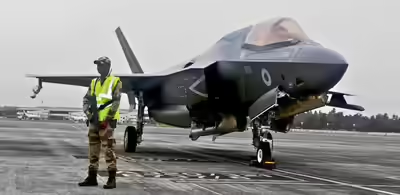
For three weeks, an ultra-sophisticated F-35B Lightning II stealth fighter jet of the Royal Navy sat motionless on the tarmac at Kerala’s Thiruvananthapuram International Airport. Valued at over $110 million, the fifth-generation aircraft is one of the most advanced—and expensive—fighter jets in the world. Its presence in India has drawn attention from aviation enthusiasts, defense watchers, and curious onlookers alike.
Now, after weeks of scrutiny and technical evaluation, the jet has finally been towed into a hangar for deeper inspection. The British Ministry of Defence has dispatched a fresh engineering team aboard a massive Airbus A400M Atlas aircraft to decide whether the jet can be repaired locally or must be dismantled and shipped home aboard a C-17 Globemaster transport aircraft.
This blog explores the events that led to the jet’s immobilization, its strategic importance, and the implications of this rare incident involving a foreign stealth fighter on Indian soil.
1. The Incident: An F-35B Lands in Thiruvananthapuram
The F-35B, known for its Short Take-Off and Vertical Landing (STOVL) capability, was part of a British Royal Navy carrier strike group undertaking deployment exercises in the Indo-Pacific region. The jet made an emergency landing at Thiruvananthapuram airport three weeks ago due to an unspecified technical malfunction while transiting between operations.
Eyewitnesses reported a smooth landing, but the aircraft was unable to take off again. Since then, the stealth fighter remained parked under heavy security, generating immense public interest and raising eyebrows in defense circles.
2. What Makes the F-35B So Special?
The F-35B is a marvel of modern military aviation. Developed by Lockheed Martin, it is a variant of the F-35 Lightning II program tailored for aircraft carrier operations and vertical landing:
- Stealth Technology: Radar-absorbing materials and angular design make it nearly invisible to enemy radar.
- STOVL Capability: It can land vertically on ships or unprepared runways—unique among supersonic jets.
- Sensor Fusion: Advanced sensors and AI integration allow the pilot to get a 360-degree view of the battlespace.
- Multirole Mission Capability: Equally effective in air-to-air, air-to-ground, and reconnaissance roles.
With over $110 million invested per unit and tens of billions poured into the development program, the F-35B represents not just a platform—but a geopolitical asset.
3. Maintenance Complexity and Repair Efforts
Maintaining the F-35B requires highly specialized infrastructure and personnel:
- The stealth coating must be repaired with precision.
- The propulsion and vertical lift system involve a complex LiftFan and Rolls-Royce engine integration.
- Diagnostic tools and software are proprietary and tightly controlled.
Over the past three weeks, British defense technicians and engineers have worked diligently at the site, attempting to fix the problem. Despite initial efforts, the repair could not be completed on-site.
This led to the arrival of a second team of engineers flown in on an Airbus A400M Atlas, a tactical airlifter designed for heavy equipment transport and military operations. The team’s mission: conduct a comprehensive evaluation and decide the next course of action.
4. The Role of the C-17 Globemaster in Retrieval
If the jet cannot be repaired locally, it may have to be dismantled and flown back to the UK aboard a C-17 Globemaster III—one of the few aircraft capable of transporting such a heavy and wide-bodied fighter jet.
This presents both logistical and security challenges:
- The F-35B’s disassembly must be done without compromising sensitive technologies.
- Customs and diplomatic clearance between the UK and India must align.
- Reassembly in the UK would require weeks of additional work before the jet can return to service.
5. Strategic and Diplomatic Dimensions
This incident is not just technical—it’s strategic:
- India–UK Defense Ties: The presence of a British stealth fighter in India for repairs underscores deepening defense cooperation.
- Military Transparency: Allowing a foreign stealth aircraft to remain in an Indian airport for weeks under observation indicates a high level of diplomatic trust.
- Regional Implications: The incident offers rare insight into NATO operations in the Indo-Pacific and the limitations of cutting-edge platforms operating far from home.
6. Public Curiosity and Media Buzz
The stranded F-35B has become a local attraction. Images of the jet parked under tarps at the edge of the runway have gone viral. Aviation buffs have been speculating on online forums, while local authorities ensured that security perimeters around the aircraft remained tight.
Meanwhile, media outlets across the globe picked up the story, often citing the unusual nature of a high-profile foreign military jet grounded in a civilian Indian airport.
7. Lessons for Future Military Logistics
This incident highlights several crucial lessons for global defense logistics:
- Self-reliance: Operating advanced jets like the F-35B requires mobile support ecosystems, especially in distant theaters.
- Contingency Planning: Even the best aircraft can suffer malfunctions. Robust recovery strategies must be in place.
- Host Nation Cooperation: Diplomacy and collaboration with local authorities are critical when such emergencies arise.
Conclusion: A High-Tech Hiccup on Indian Soil
As engineers continue to assess the stealth fighter in the hangar at Thiruvananthapuram, the world watches with interest. Whether it flies again from Indian soil or is disassembled and repatriated, this episode stands as a stark reminder of the complexities involved in operating next-gen military platforms globally.
More than just a repair operation, this situation underscores the delicate balance between technology, diplomacy, logistics, and strategy. For India, it has been a front-row seat to the challenges of modern military aviation. For the UK, it’s a lesson in preparedness and projection of power far from home.
And for the F-35B—one of the most advanced flying machines on Earth—it’s a humbling moment on the sunlit tarmac of Kerala.





 myNative.in
Leave a comment